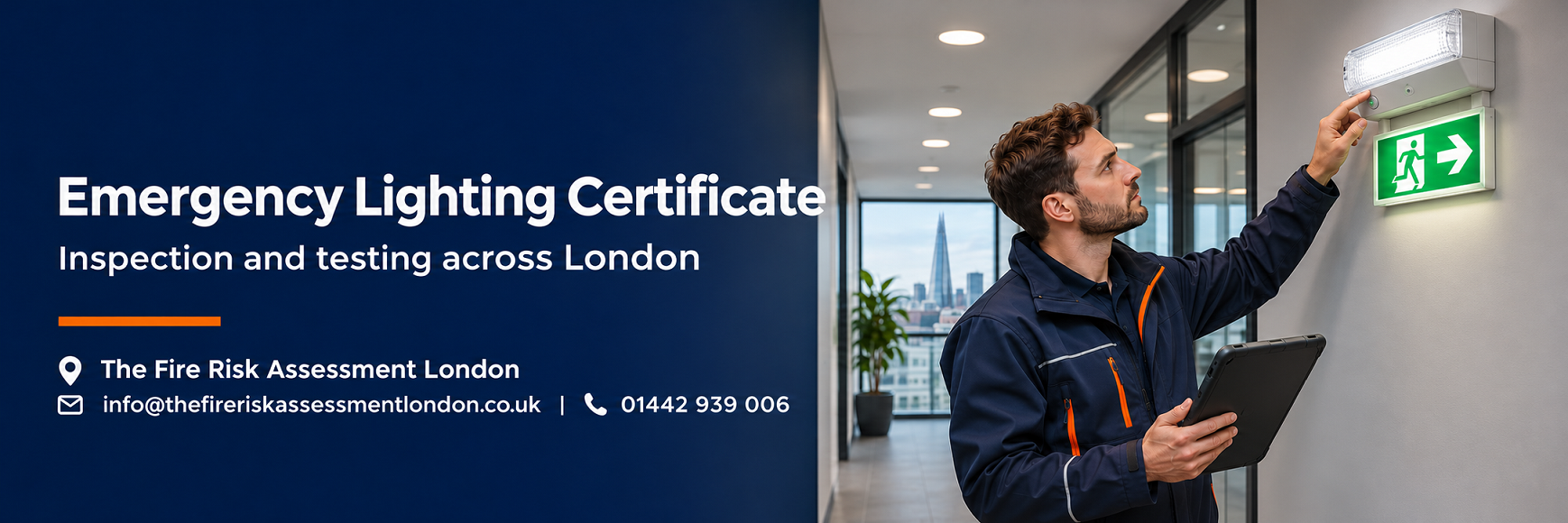
When the power fails in a fire, the main lights go out, and then escape routes turn pitch black within seconds. Above all, emergency lighting is what lets people find the stairs, the exits and the way out. An emergency lighting certificate is your written proof that those lights actually work: a competent person has tested every fitting, the batteries have lasted their full rated duration, and the engineer has recorded any faults.
We test and certify emergency lighting for landlords, HMOs, blocks of flats, managing agents and businesses across the UK, with most of our work in London, Hertfordshire, Bedfordshire and Buckinghamshire. In addition, prices start from £120 plus VAT for up to 10 lights, and we fix every quote before we arrive. So if you need an emergency lighting certificate for an HMO licence, an insurer, a fire risk assessment action or simply peace of mind, call us on 01442 939006.
An emergency lighting certificate is a document issued by a competent person after inspecting and testing an emergency lighting system. It also confirms that the system complies with the British Standard for emergency lighting, BS 5266-1, at the time of the test, and lists anything that needs fixing.
There are two main types:
For this reason, keep both with your emergency lighting logbook and your fire risk assessment. In fact, they are among the first documents a fire officer, council licensing officer or insurer will ask to see.
The law does not use the word “certificate”. However, it does require you to prove your emergency lighting works. In England and Wales, the Regulatory Reform (Fire Safety) Order 2005 says the responsible person for any non-domestic premises, including the common parts of flats and HMOs, must keep fire safety equipment in efficient working order and good repair. Emergency lighting is part of that. Similarly, Scotland and Northern Ireland have their own fire safety laws with the same basic duty.
In other words, an annual emergency lighting certificate is how you show you have met that duty. Without one, you have no evidence that anyone has tested the lights. As a result, you have little defence if there is a fire, an enforcement visit or an insurance claim.
BSI fully revised the British Standard for emergency lighting in 2025. BS 5266-1:2025 came into effect on 31 October 2025 and replaced the 2016 edition, which is now withdrawn.
The biggest change, however, is scope. The old standard focused on emergency escape lighting. The new edition also covers local area lighting and standby lighting, and it lines up with the updated European standards BS EN 1838:2024 and BS EN 50172:2024. Equally, it still applies to the common parts of blocks of flats and maisonettes, but not to the inside of private homes.
Even so, many websites and contractors still quote the 2016 standard. Our certificates, on the other hand, refer to the current edition, so your paperwork is up to date.
BS 5266 sets out a simple routine:
In fact, batteries are the most common failure. For instance, a light can pass the monthly flick test and still fail after twenty minutes on the annual test, which is exactly why the full-duration test matters.
On the day, we first work through the whole system, not just the fittings you can see. A typical visit covers:
We also plan the test around your building. Because the lights need time to recharge afterwards, we can split larger buildings into sections to keep some lighting available at all times.
After the test you receive:
We also write everything in plain English, so you can forward it straight to your council, insurer, managing agent or leaseholders.
Of course, not every HMO needs emergency lighting. It depends on the size of the property, the layout of the escape route and whether people could use it safely in the dark. Instead, your fire risk assessment and the council’s licence conditions decide. For example, Hammersmith & Fulham’s HMO standards expect emergency lighting in three-storey HMOs and bedsit HMOs.
In addition, where an HMO has emergency lighting, councils usually expect to see an up-to-date certificate as part of the licence application or renewal, alongside the EICR, the fire alarm certificate and the fire risk assessment. If you are applying for a licence, see our HMO fire risk assessments. For converted houses and purpose-built blocks, our fire risk assessments for flats cover the common parts, including emergency lighting.
The cost of an emergency lighting certificate depends mainly on how many emergency lights there are, how easy they are to reach, and where the building is. As a result, the more lights you have, the lower the cost per light. Here is our typical pricing:
| Number of emergency lights | Typical price (plus VAT) |
|---|---|
| Up to 10 lights | £120 to £150 (minimum visit charge) |
| 11 to 25 lights | £150 to £220 |
| 26 to 50 lights | £220 to £350 |
| 51 to 100 lights | £350 to £600 |
| 100+ lights or multiple sites | £4 to £6 per light, fixed quote on request |
In short, prices cover the annual full-duration test, the certificate and the logbook update. However, we quote separately for replacement batteries and fittings, and we only fit them with your approval. Finally, buildings outside London, Hertfordshire, Bedfordshire and Buckinghamshire may include a travel charge, which we always show in the quote.
Booking a fire risk assessment or a fire door inspection as well? We can do them on the same visit and save you a second call-out. Ask for a combined quote.
We carry out emergency lighting tests and certification across the UK, with most of our work in London and the Home Counties, including:
Searching for an emergency lighting certificate near me? If your town isn’t listed, however, give us a call. In addition, we cover the Midlands, the North, Wales and Scotland for landlords, managing agents and national portfolios.
Our prices start from £120 plus VAT for up to 10 emergency lights. For example, larger buildings cost less per light, from around £4 to £6 per light for 100 or more. We fix every quote before we visit.
There is no fixed expiry date in law. However, the full-duration test is due every 12 months. Therefore, you should renew your emergency lighting certificate every year.
A competent person with the knowledge and test equipment to inspect the system to BS 5266-1. In most cases, this is an electrician or fire safety engineer experienced in emergency lighting.
You can, and should, do the monthly function test yourself and record it in the logbook. However, a competent person should carry out the annual full-duration test and issue the certificate.
First, we record the failure on the certificate. Then we quote for the repair. Generally, most failures are worn-out batteries, which we can often replace on the same day. You should also fix a failed fitting promptly, and before the next monthly test.
If the HMO has emergency lighting, yes. For example, councils normally expect an annual certificate as evidence for the licence. However, whether a property needs emergency lighting at all depends on the fire risk assessment and the council’s standards.
Yes. Most of our work is in London, Hertfordshire, Bedfordshire and Buckinghamshire, but we provide emergency lighting certificates across England, Wales, Scotland and Northern Ireland for single properties and national portfolios.
To get started, tell us the property address, the type of building and roughly how many emergency lights there are, and we will send you a fixed quote for your emergency lighting certificate. Call 01442 939006, email info@thefireriskassessmentlondon.co.uk or use our contact page.